
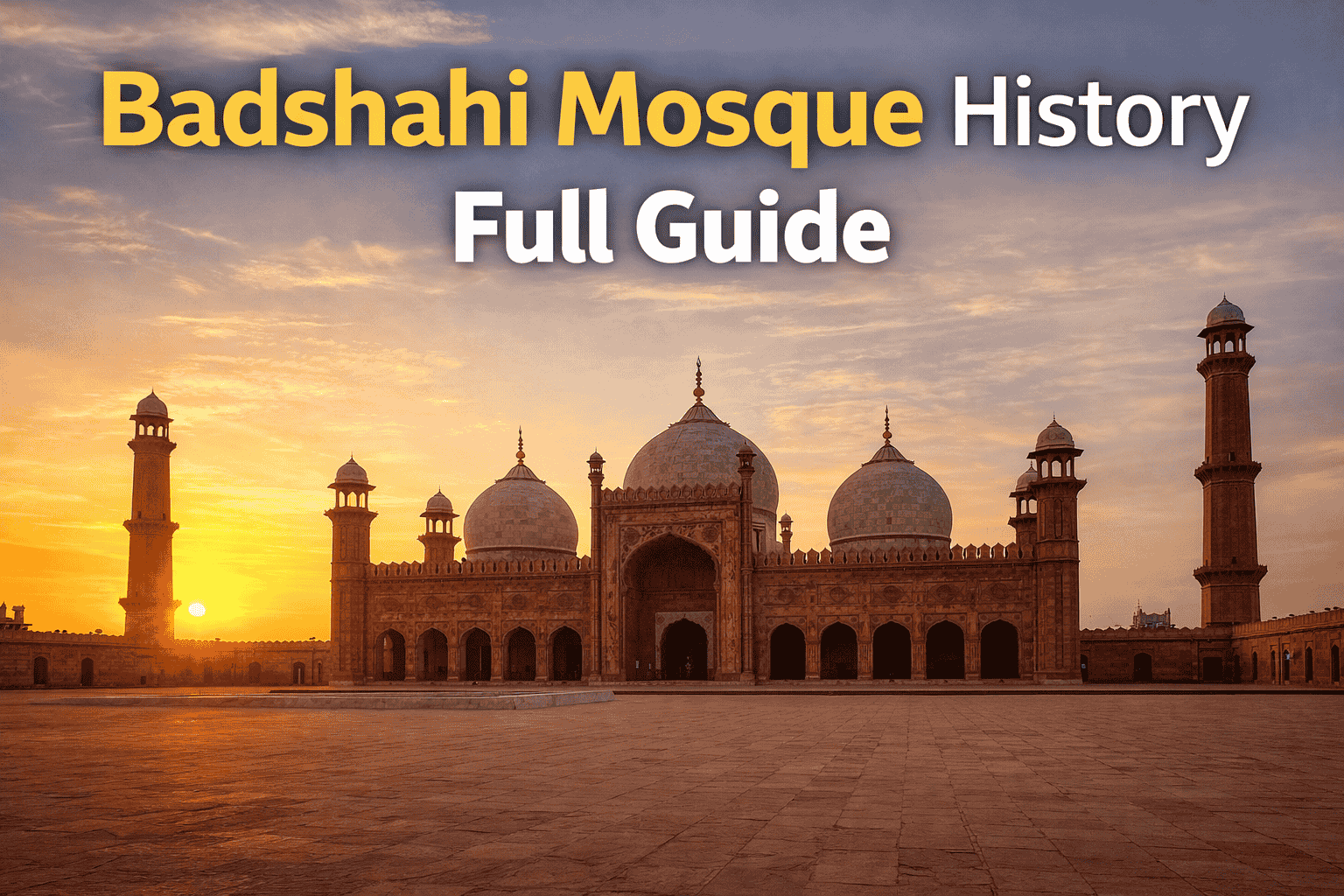
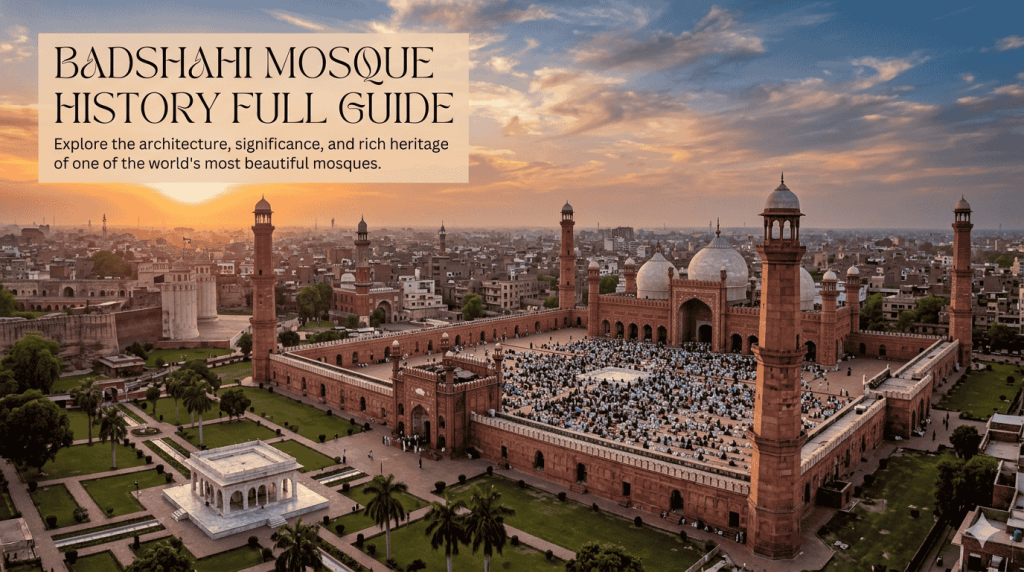
Badshahi Mosque History Full guide.
One of the most symbolic sites of Pakistan and a manifestation of the Mughal architectural grandeur is the Badshahi Mosque that is located at the heart of Lahore. It is a masterpiece of Islamic architecture, history, and culture as it was constructed under the reign of Emperor Aurangzeb towards the end of the seventeenth century. The mosque is not only visited by millions of tourists every year but it is also used as a vibrant religious and cultural centre.
This guide explores the history, architecture, meaning, and main attractions of the Badshahi Mosque as well as tips that should be considered as a visitor.
Historical Background
Badshahi Mosque is an Indian Mosque commissioned in 1671 and finalized in 1673 by the Emperor Aurangzeb Alamgir. It was built in order to show the might, riches, and the religious piety of the Mughal Empire when it was in full blossom.
The sixth Mughal emperor was Emperor Aurangzeb, who was famous in his adherence to Islam and orthodox policies, and the mosque also exhibited his idea of the majesty and simplicity.
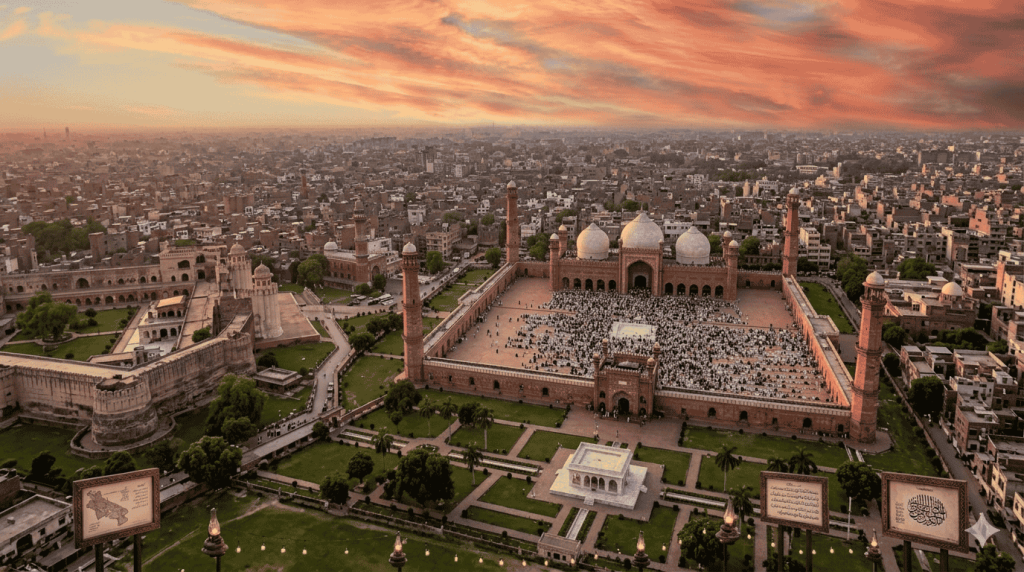
The mosque was constructed along the Ravi River, adjacent to the Lahore Fort, and was used as the symbol of authority as well as a place of worship.
When it was constructed, it was the biggest mosque of the world and one of the biggest mosques in South Asia centuries afterwards.
The mosque was essential in the history of Lahore as it witnessed the development and collapse of empires, as a religious school and community meeting place.
Architectural Significance
Badshahi Mosque is the true masterpiece of the Mughal architecture combined with Persian, Central Asian, and Indian styles. It is designed in a manner that places special focus on symmetry, grandeur and careful craftsmanship.\
Key Features:
Main Prayer Hall
The mosque has a large prayer hall that has a capacity of holding more than ten thousand people at once.
The hall is made out of red sandstone and white marble inlays with elaborate floral designs and inscriptions that have been inscribed on the walls.
Mughal craftsmen can be traced in high arches and domes and fragile frescoes.
Domes
The mosque has three giant fading domes as well as eight smaller domes that cover the main structure.
The main dome is 54 metres in height that forms a magnificent skyline that can be seen in distance.
Along the domes, there are marble carvings and decorations.
Minarets
There are four tall towering towers 54 meters high at the corners of the mosque.
They are made of red sandstone and marble, and are used to a decorative and practical effect specially, as regards the adhan (call to prayer).
Courtyard
The mosque has a large court/yard measuring about 276000 square feet that can host one hundred thousand worshippers during the key religious occasions.
The courtyard has ablution fountains and flooring that is made of marble.
Entrance Gates
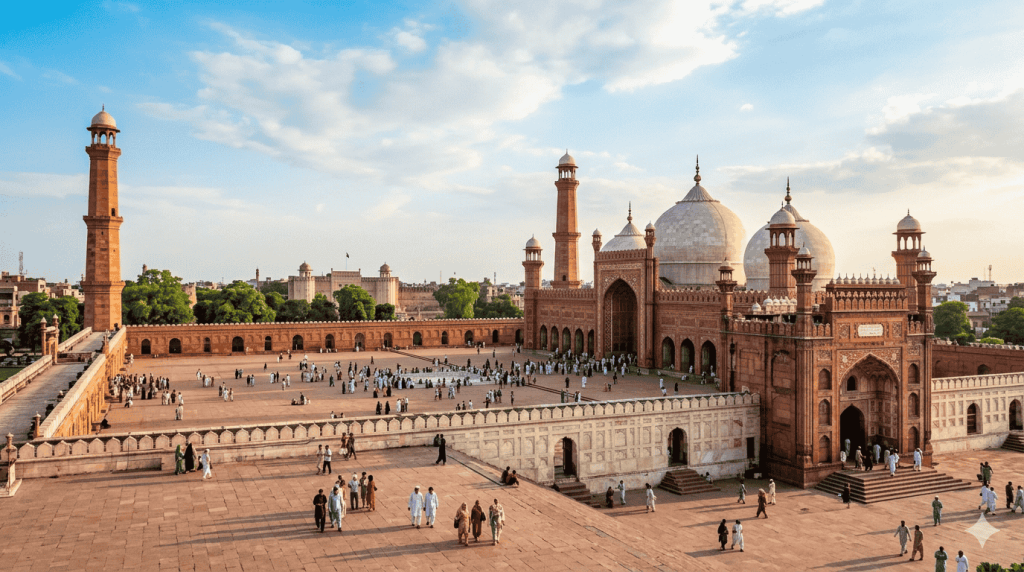
The mosque boasts of three main entrances that are adorned with dramatic gates and elaborate carvings.
Daily worshippers use the north and south gates, whereas the main gate is towards the Lahore Fort.
Decorative Elements
Badshahi Mosque boasts of calligraphy, frescoes and pietra dura that are characteristic of Mughal design.
White marble is used to inlay the red sandstone walls and make them look very stunning.
Cultural/Religious Significance.
Badshahi Mosque has been a seat of Islamic worship, cultural events as well as Islamic education over centuries.
It also conducts prayers on Fridays, Eid gatherings, and other religious occasions, and is attended by thousands of worshippers.
The Mughal period was a time of accumulation of scholars and students in the mosque to obtain religious education and Islamic studies.
The mosque also serves as the reminder of the rich Islamic heritage of Lahore, which is visited by both Pakistanis and foreigners.
Besides religious use, Badshahi Mosque has served as a cultural icon (it featured in films, documentaries, and literature) as a representation of Mughal art and architecture.
Restoration and Preservation.
Over centuries, Badshahi Mosque has been demolished by natural wear and invasion as well as political transformations.
Some of the mosque was utilized in military activities by the Sikhs and this impacted negatively on its structure.
Restoration work that led to the preservation of the architectural integrity of the mosque was done during the British colonial period.
The mosque today is being preserved and maintained by the Government of Pakistan and heritage organisations.
The contemporary restoration involves structural strengthening, marble surface cleaning, and frescoes and inscriptions preservation.
Visiting Badshahi Mosque
Timings and Entry
Visitors are also welcome in the mosque during the day but not during prayer hours.
One needs to wear modest clothes and remove his shoes before entering the prayer hall.
Things to Do
Visit the Prayer Hall: See the arches, inlays of marble and the Quranic calligraphy.
Stroll the Courtyard: Get to know the great size and symmetry of the mosque.
Photography: Shoot the architectural elements, domes, and minarets especially at the sunrise or sunset.
Learn History: Tour of plaques and local guides to learn about the history of the mosque.
Places of Interest: Visit with the tours of the Lahore Fort, Hazuri Bagh and Walled City.
Interesting Facts
Third-Largest Mosque in the World: It was the largest mosque in the world at the time of its construction, coming second to the Masjid al-Haram in Mecca.
Red Sandstone Glory: More than a hundred thousand tonnes of red sandstone were used to construct it.
Famous Festivals: Everyday the mosque welcomes huge groups of worshippers on Eid-ul-Fitr and Eid-ul-Adha.
Historical Witness: The mosque has experienced the Mughal rule, Sikh occupation, British colonialism and independence of Pakistan.
Architectural Influence: Its design had an impact on subsequent Mosques in Lahore and elsewhere in South Asia.
Travel Tips for Visitors
Dress Modestly: Wear full-sleeved cloths that cover hands and legs.
Respect Prayer Times: Do not interfere with worshipers during prayers.
Photography: Photography is not forbidden, however, it is not allowed to use flash in the prayer hall.
Guided Tours: When you get a local guide, it gives you historical background and cultural information.
Become a Tourist: Go to Lahore Fort and Hazuri Bagh to have a complete historical experience.
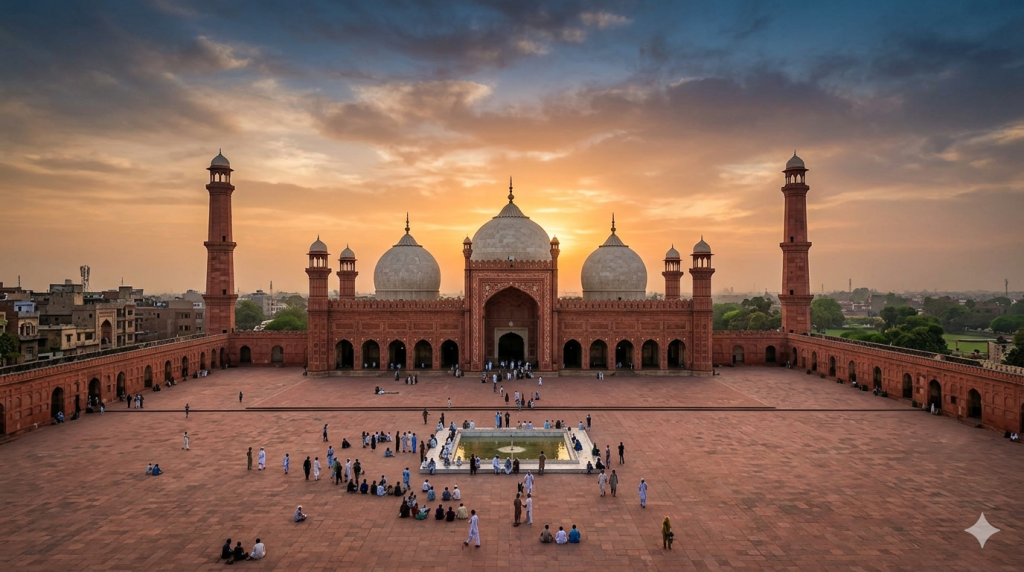
Time: It should be early in the morning or late in the afternoon when the weather is pleasant and light is soft to take pictures.
Why the Badshahi Mosque is Iconic.
Badshahi Mosque is not just a worship house it is also an identity to the rich Mughal heritage that Lahore has. Its monumental architecture, historical and cultural value make it a must-visit place to both tourists and the locals.
Characterizes Mughal engineering and architecture fineness.
Being a cultural and religious heritage site over the centuries.
Gives details on the art, calligraphy and heritage of Muslims.
The photographer heaven with marvelous sights of the Lahore Fort and the city around.